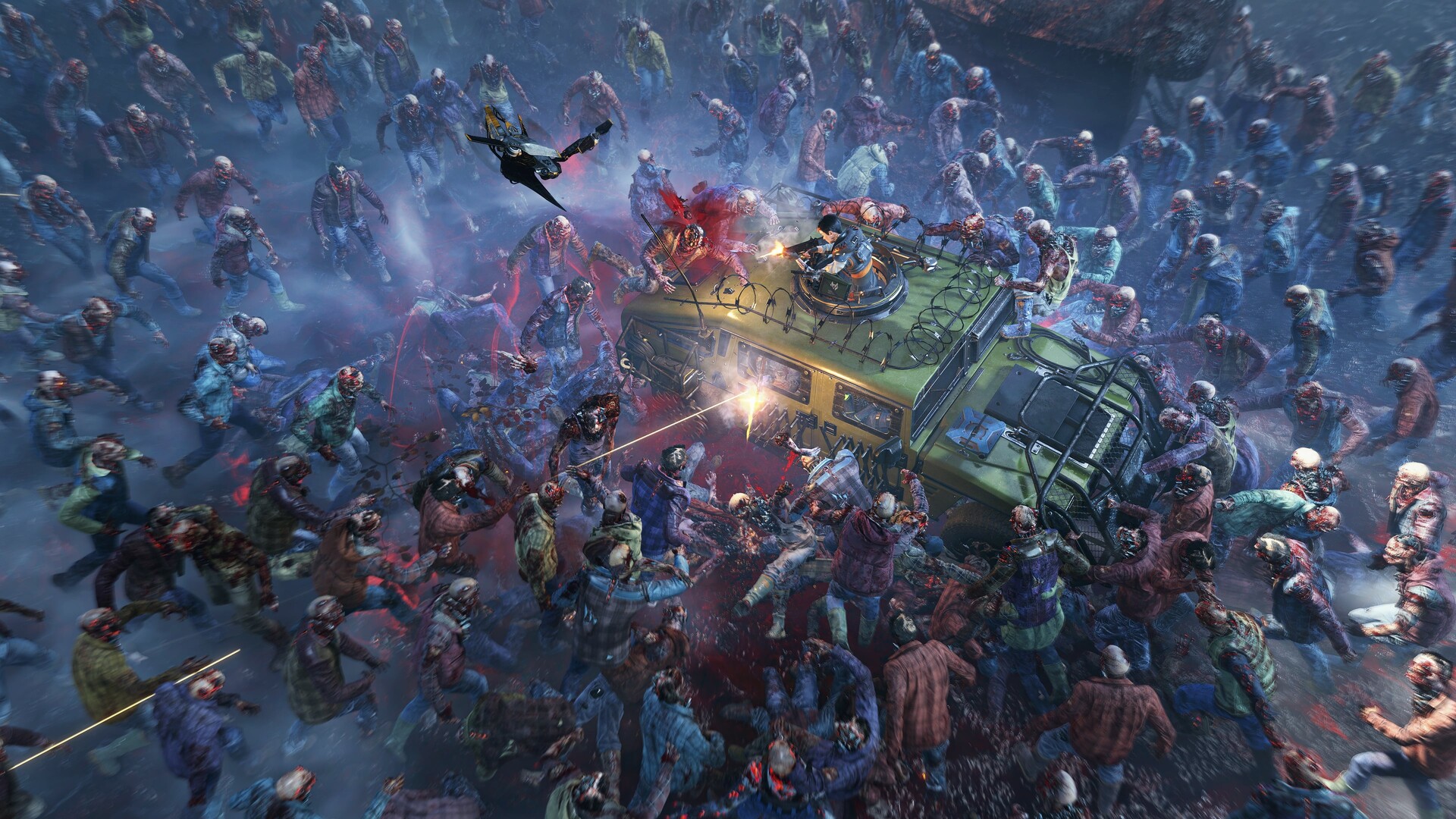
John Carpenter’s Toxic Commando is now live across PC and consoles, and you get to pick between four different classes.
Once you’ve cleared the tutorial mission, you can then choose any class you like. However, every class has its own strengths and weaknesses. Moreover, no two classes operate in the same fashion. So let’s look at how the classes work in the current meta.
Table of contents
Complete John Carpenter’s Toxic Commando class tier list
To separate the classes, I have used two tiers. All four classes appear to be pretty effective, but there are some subtle differences.
- S-tier classes appear to be the best ones to use. Their loadouts and ease of use make them the top choices.
- A-tier classes are almost as good as the S-tier choices, but they slightly fall short. They’re either relatively niche or the class might be slightly difficult to master.
S-tier
- The Operator: The Operator is an exceptional class, and more so if you’re playing solo. The class comes with a battle drone that provides you with constant support throughout the mission. You’ll supercharge it whenever you use your ability. You can pretty much spam the drone thanks to the rate at which you recover your energy. While the class really shines solo, it can be an equally great addition when you’re playing with other players.
- The Defender: Every team needs a brute force to drive through, and that’s where the Defender comes in. This is the staple tank class of the game, and it can form a protective dome for all. The dome can be destroyed, but it will absorb a lot of incoming damage from the zombies. The Triad ability is pretty fun since it allows you to place three small barriers. However, it’s the Rupture and the Aegis skills that will truly allow you to stop the undead.
A-tier
- The Medic: I love the Medic, and I plan to play the class a lot. The class becomes more important when you’re playing with other players. You can create a ring that regenerates HP, and at level 5, you can change the position of the ring. Once you get more upgrades, your speed of providing heals will improve, and you can also access healing grenades. However, the potential of this class will largely depend on whether you’re playing in a group. If you’re using solo play, the Medic doesn’t have much of an use.
- The Strike: This might be a good class to learn the game and its mechanics, but you lack specialization with the Strike. You can use an explosive fireball to do major damage, and you can spawn more than one of them. The upgrades allow you to power up your fireballs and also unlock the plasma cutter later. However, it’s a class that’s heavily reliant on explosives and lacks direct firepower. Also, explosives are something that rarer weapons can easily replace. All three other classes appear to offer more value to me, irrespective of whether you’re playing solo or in a group.
The post John Carpenter’s Toxic Commando class tier list: which one should you use appeared first on Destructoid.
Setting up an amazing squad in Monster Hunter Stories 3: Twisted Reflection is easier said than done, as you’ll need to look for monsties with the best possible stats.
This task is easier said than done. While you can always hatch the best of eggs, that doesn’t guarantee a perfect monstie. Instead, you’ll need to look for something called genes and master the concept.
Table of contents
How do genes work in Monster Hunter Stories 3: Twisted Reflection
Every monstie has a dedicated set of Active and Passive skills. The number and types of skills of a monstie are determined by genes. If you refer to the image below, you’ll find a young Rathalos that’s available for all of us at the start of a journey.
Notice the bottom right corner, and you’ll find nine slots in a 3×3 grid. This grid is applicable for every monstie when they hatch. Some of the slots will be filled, and some will be empty. To get your perfect mostie, you’ll need to fill these empty slots. Having nine filled slots will give the mostie the best set of skills.
While not all their slots might be filled at the start, you can inherit additional genes from other creatures. To do so, you need to understand how Bingo and Rite of Channeling work.
How does Rite of Channeling and Bingo work in Monster Hunter Stories 3: Twisted Reflection
Rite of Channeling allows you to switch the genes from one monstie to another. You can do so in different ways.
- Directly swap the genes from one monstie to another.
- Manually select which gene/genes you want to swap.
- Select the monsties and the genes you want to swap.
Once the swap is complete, you can continue to modify the genes of your selected monstie until you’ve filled all nine slots. However, randomly filling the slots is not the most optimal thing to do.
When you use Rite of Channeling, you should match up genes to get the maximum possible bonus. If you manage to do so, your monstie will have an extra 5% damage as a bonus for all Power attacks. To do so, you need to match three Power genes in a row. You can match them vertically, horizontally, or diagonally.
You’ll get the bonus damage for a Bingo even if the associated element and attack type don’t match. If they do, however, then you can get multiple Bingos in a single row.
To build up your perfect monstie, Excursions are important as well.
How do Excursions work in Monster Hunter Stories 3: Twisted Reflection
You can send your monstie on an Excursion to make it gain different stat bonuses and Environment Skills. To do so, you’ll need Training Talisman, which can be purchased from the Melynx Emporium. They’re expensive, so you should ration them properly. Additionally, only one monstie can be sent on an Excursion at any time.
To gain Environmental Skills, you’ll need to pay attention to whether the monstie was present in that region. If you add a monstie to a habitat and then send it on an Excursion at the same place, it will be able to learn new skills based on their Environment Rank.
The ultimate aim is to have three S-rank Environment Skills active on your monstie at once. Three is the maximum number of Environment Skills any monstie can have. If you send them to a region they’re unfamiliar with, your monstie will only learn the stat bonuses.
Every Environment Skill has three ranks for each region: B, A, and S. Your monstie can access the Skill if their Ecosystem Rank matches the region’s grade. Additionally, you can also Awaken every Environment Skill if your monstie has the required genes.
The post How to get a monstie with best genes in Monster Hunter Stories 3: Twisted Reflection appeared first on Destructoid.
Recommended Story For You :
Think of it as a GPS system for World of Warcraft

FIFA 2023 ULTIMATE TEAM MILLIONS MADE EASY
Joana's Clssic WotLK 1-80 & Era 1-60 Speed Leveling Guides

Empowering Gamers with the Ultimate Secret Gold Guide
A Practical Guide For Tactical Gaming
Terra Game - Where Adventure Awaits!