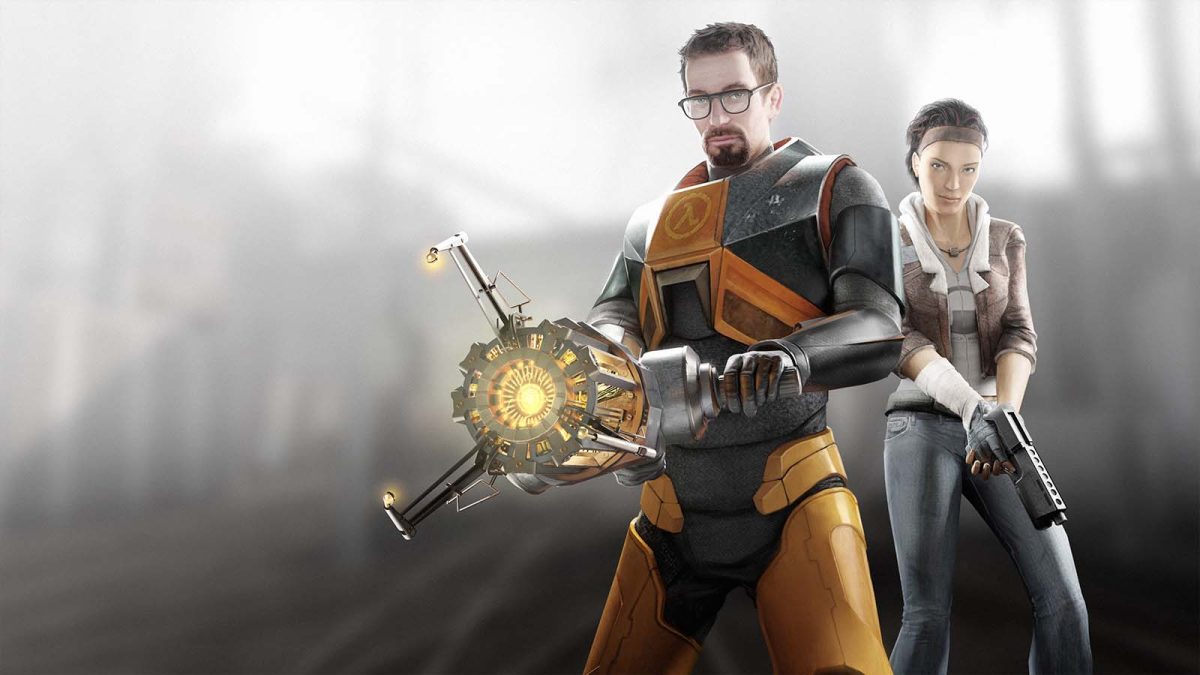
I’m sorry, but chances are we aren’t getting Half-Life 3 anytime soon. Also, it was definitely never going to be shown at an awards show because Valve simply doesn’t need that. You can, however, play a bunch of modern FPS titles that carry Half-Life‘s flame with great finesse.
Titanfall 2
If you know the basis of Titanfall, you’ll probably think I’m trying to deceive you, as big robot action is exactly the opposite of deep and smart FPS gameplay. Well, the industry seems to have fallen to a spot where you can only have one or the other, but Titanfall 2 is a miracle in that sense. It features some of the most enthralling sci-fi action out of any media, but it also infuses it with extremely fun and well-thought-out mechanics you don’t see anywhere else. You don’t even see anything in this game to the point of getting tired, as Titanfall 2 is so filled to the brim with well-executed ideas that it’s trying new stuff and challenging the player with wholly new mechanics in every single level.
Though its unbelievably immersive action might blind you to that fact, Titanfall 2 features one of the smartest and most brain-teasing single-player campaigns out there.
The Talos Principle 2
What if you want a game that’s even more of a brain teaser than Half-Life 3 would be? Then The Talos Principle 2, or the original, if you still haven’t played it, is the game for you. It’s absolutely gorgeous, features writing on par with what you’ve seen in the best FPS you’ve ever played, and will absolutely put your grey matter to the task. Whereas players won’t be doing any shooting per se, The Talos Principle games clearly have FPS in their DNA. They’re made by Croteam, the studio behind the equally awesome, but admittedly less smart, Serious Sam games, and their expertise is on display here at all times.
Interestingly, Croteam only got propelled to the big leagues after Old Man Murray, the gaming website owned by future Valve writers Chet Faliszek and Erik Wolpaw wrote about how awesomely promising Serious Sam’s first demo was, so I guess you can really make the case for The Talos Principle being a true Half-Life torchbearer.
Prey
I love the original Prey, the one from ’06, and I wholeheartedly recommend you play it, even though it apparently already counts as “old.” If you want something new, however, something great, something that wears its many Half-Life influences on its sleeve, then you can do no wrong with Prey. Do you enjoy prop hunt style games? Well, the devs behind Prey at Arkane had the incredibly risky idea of using the concept of prop hunting as a central theme, and the strangest part is that it works. Though it feels and plays nothing like its predecessor, nu-Prey is a fantastic FPS about using one’s brain to navigate all sorts of lies, and, courtesy of a very original arsenal, also a very fun game at that.
Half-Life Alyx (Without VR)
This might seem obvious at first, but it is not. If it seems obvious to you, that’s because you’re fortunate enough to own a VR headset that allowed you to play this one upon release, and are now sad that you don’t get to enjoy anything of a similar caliber. Most didn’t get the chance to play Half-Life Alyx, a flawed but fascinating title, the first and only attempt at making a AAA game for VR.
It sucks that many didn’t get to play it, because it does take the first steps into what might one day become Half-Life 3, because it spent too long being gatekept by expensive tech. Now, while a VR headset remains the best way to enjoy Half-Life Alyx, players can play it without a VR headset with the help of a mod, and it’s great. It’s not as immersive, sure, but it still has enough of that Half-Life juice to remain more immersive than most games out there, so you really shouldn’t sleep on this one, especially if you want to be ready for Half-Life 3’s shadow drop.
The post Half-Life 3 might never come to be, but these games can ease the pain appeared first on Destructoid.
To say Destiny 2 had a bad 2025 is quite the understatement, like saying Mint Retrograde and the Praxic Blade are just alright. This year was nothing short of a disaster for Bungie’s flagship title, even with Renegades showing signs of a recovery.
2026 will be a decisive year for Bungie, a studio whose entire 2025 was a make-or-break moment. The developer is under new direction and Marathon is finally releasing. Just keeping Destiny 2 alive isn’t the bar to aim for in 2026, especially given how much it struggled to do so with The Edge of Fate.
There’s a lot I’d love to see change inside the game come 2026. But a positive future for Destiny 2 has to fix the frayed relationship between jaded players and an embattled developer—at the risk of breeding apathy and alienating even more of its fanbase.
Less dependence on the Portal
The Portal was The Edge of Fate‘s main way of engaging with the game, and Destiny 2 struggled for it. Anything that wasn’t in the Portal was essentially useless for leveling up, and boosting your Power was the only way to get higher-quality gear.
The Portal can be a decent way of playing Destiny 2, but it should not be the only way to play the game. For a rich universe, pigeonholing players into a dozen activities that appear in a Netflix-esque menu is about the least interesting way to slice it.
Renegades already started correcting this by offering the Lawless Frontier, and it’s certainly helped keep our adventures in the Sol System far fresher than before.
More gear, destinations, and activities—even if they’re reissued
Renegades‘ praise highlights there is life outside the Portal, and next year is a prime opportunity to reissue loot from older raids and dungeons. Tier-compatible weapons and armor would go a long way toward replayability, especially if they’re not entangled in a messy web of modifiers.
Of course, there’s a lot of work involved in updating weapons’ perk pools and making armor set bonuses, and it may not be viable, but it would give us a reason to redo activities like Duality.
We’d also love to see more room for exploration returning next year. New territories are always welcome, but destinations and old seasonal activities such as The Derelict Leviathan or The Nether are ripe for that kind of adventure, especially in a non-Portal format. And what is the Lawless Frontier if not a timed, Star Wars Nether?
More unlockable cosmetics
That one is, surprisingly, something Bungie has finally been doing after years of fan requests. Nonary Engrams in Rite of the Nine, the New Malpais ornament and unique helmet in Call to Arms, Iridescent Engrams, and Renegades‘ Dark Matter Crystals are remarkable reasons to keep logging in and playing, and we’d love to see more of them going forward.
Iridescent Engrams in particular are an easy, exciting addition due to having meaningful rewards and guaranteeing new items. It’s a wonder Bright Engrams can even drop duplicates, because the only thing more riveting than a purple sparrow you’ll never use is a purple sparrow you’ll never use but already have.
Less greed
The Eververse store has been around Destiny 2 for ages, but The Edge of Fate really made it feel like it was at the forefront. Season passes started having 110 rewards for the equivalent of 150 levels, and it’s hard to forget the unforgivable Gladius set fiasco.
Bungie took a ravishing set of armor and removed it from the (free) Iron Banner PvP mode, only to sell it for premium currency as a new set, presenting a reskin of ancient armor to the mode instead. Fans would have been none the wiser about this shady practice if they hadn’t uncovered (now-deleted) concept art that showed the Gladius set with the Iron Banner logo. Bungie threw a separate would-be Eververse set in the mix, but by then, the damage was clearly done.
And the greed doesn’t just translate to how Bungie handles money, either, but how the studio seemed to want to squeeze every drop of playtime from its community. Bungie’s easiest wins were the times when it reverted The Edge of Fate‘s changes, such as toning down the egregious grind, removing a reset in Renegades, and sunsetting Unstable Cores. The relationship between player and developer isn’t as bad as it was months ago, but it still requires a lot of work. Reimplementing Dawning bounties and being more generous with Bright Dust caps would have been a good gesture.
Creating goodwill and actually building meaningful momentum
We know Bungie isn’t in its best state. We understand it doesn’t have the same workforce it once did, and it can’t deliver the same quantity or quality of content. But instead of owning it, the studio seemed intent on pretending that wasn’t happening.
Its relationship with the community in The Edge of Fate felt almost antagonistic, with predictably awful changes and an inaction that couldn’t have been an accident. Player counts kept dropping, feedback kept piling up, and the community perceived the studio as helpless. Bungie can’t afford that perception again next year.
Community manager Dylan “Dmg_04” Gafner’s infamous “we need to build momentum and maintain it” post in September became nearly a meme in the community, especially after the lukewarm Ash & Iron update the following week. Bungie hasn’t really achieved it still: even with Renegades‘ popular acclaim, the feeling may be closer to a feeble, cautious optimism caused by a fluke rather than an actual impetus forward.
Next year, I hope to see Bungie embrace more of the community that’s been with it through thick and thin. It’s about removing obstacles rather than creating new reasons to play anything else. More communication also helps, especially if that comes accompanied by timely responses that take player feedback into account. Yes, fixing issues in Renegades is good, but fixing them three months earlier, when the game was hemorrhaging players, would have been even better.
Focusing on what’s outside the game
I could write an entire grimoire on the gameplay changes I’d love to see. I’d be happy with Exotics finally being tier five, a system that lets you choose armor sets like Festival of the Lost’s masks, a tuning pass to weapons, an economy overhaul, and far more forgiving caps on Bright Dust from orders next year. But the part where Bungie really has to put in work happens before we even launch Destiny 2.
This is not the time to create any attrition or make players hesitate to open the game. It’s not the moment to leave guardians staring in apathy at the title screen and wonder if it’s worth jumping through all the hoops, like it was in The Edge of Fate.
Instead, it’s about giving players more incentive to keep coming back because they want to, not because they feel they have to. Sure, a lot of it hinges on providing meaningful, quality content for players, but that’s not all it is. Maybe that means cranking up the faucet a little and offering a lot more freebies to newcomers, lapsed players, and veterans alike. Maybe it just means not messing up in decisive moments or loosening the grip. That way, we won’t have to take a loud sigh whenever someone asks if they should start playing.
The post Destiny 2 almost died in 2025. Here’s what we want to see from it next year so it doesn’t happen again appeared first on Destructoid.
Recommended Story For You :

Think of it as a GPS system for World of Warcraft

FIFA 2023 ULTIMATE TEAM MILLIONS MADE EASY
Joana's Clssic WotLK 1-80 & Era 1-60 Speed Leveling Guides

Empowering Gamers with the Ultimate Secret Gold Guide
A Practical Guide For Tactical Gaming

Terra Game - Where Adventure Awaits!