🇩🇪🤝🇬🇧 Germany–UK Mutual Defense Pact: A New Era in European Security

Overview
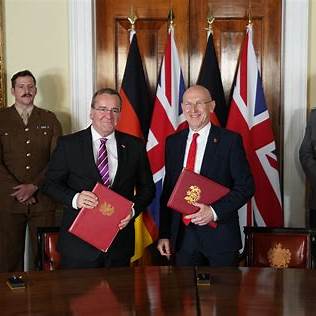
Germany–UK Mutual Defense Pact. On July 17, 2025, Germany and the United Kingdom will formally sign a new mutual defense treaty—a landmark pact promising that a strategic threat to one nation will be deemed a threat to the other. Building on an October 2024 agreement (the Trinity House Agreement), this treaty represents a major advancement in bilateral defense cooperation and Europe’s broader strategic autonomy seekingalpha.com+10reuters.com+10govconexec.com+10.
1. The Context: Rising Geopolitical Risks
NATO and the Indo-Pacific
Despite both nations reaffirming their NATO commitments, the pact marks Europe’s push toward greater defense self-reliance from the U.S., especially under potential shifts in American policy amid tensions in the Indo-Pacific and possible U.S. isolationism reuters.com.
Russia’s Shadow
Russia’s enduring aggression in Ukraine has acted as a catalyst. Berlin and London are increasingly aligning their military strategies—notably with joint exercises in Eastern Europe—to present a united front .
2. From Declaration to Treaty
Trinity House Agreement
The October 2024 Trinity House Agreement—signed by John Healey and Boris Pistorius—outlined closer coordination on missile defense, maritime monitoring, submarine patrols, and munitions production english.nv.ua+11ft.com+11en.wikipedia.org+11.
Political Blueprint
In August 2024, Prime Minister Keir Starmer and then–Chancellor Olaf Scholz issued a joint declaration to deepen trade and security linkages. The treaty is the first formal instrument emerging from that pact reuters.com+4reuters.com+4politico.eu+4.
Treaty Signing
Politico reports the treaty finalized after 18 negotiation rounds, and plans signing before parliamentary summer recess—on July 17, 2025 govconexec.com+3sofx.com+3english.nv.ua+3.
3. Core Provisions of the Treaty
Mutual Assistance Clause
Identical to NATO’s Article 5, it commits each to aid if the other faces a strategic threat—whether military attack, cyber warfare, or critical threats to national infrastructure .
Reinforcing NATO’s Eastern Flank
Building on post-Trinity House initiatives, shared military exercises in the Baltic states and increased joint command functions behind deterrence lines are included en.wikipedia.org.
Maritime Security
German P‑8 Poseidon maritime patrol aircraft will conduct regular missions from RAF Lossiemouth, monitoring Russia’s submarine activity and protecting critical infrastructure in the North Atlantic and North Sea newsweek.com+5thetimes.co.uk+5independent.co.uk+5.
Deep-Strike Weapons Development
A 2025 Reuters report confirmed plans for a 2,000‑km range precision missile, a joint UK‑Germany venture—part of a continental deep‑strike capability reuters.com.
Defense Industrial Integration
Germany’s Rheinmetall will manufacture 120 mm and 155 mm artillery barrels in the UK from 2027, reconnecting Britain to continental defense supply chains, supported by UK steel production ft.com. Further industrial collaboration includes drone engineering and air defense systems integration.
4. Strategic and Political Implications

Europe’s Strategic Autonomy
Excluding the U.S. from key NATO missions has signaled a desire to supplement and safeguard Europe’s own defense mechanisms—reducing strategic dependence amid U.S. unpredictability thetimes.co.uk.
Uplifting Defence Spending
According to AInvest, this treaty implicitly calls for defense budgets to rise from 2% to 3% GDP, and Germany’s decision to exempt defense spending from debt constraints supports long-term military investment ainvest.com.
Industrial and Economic Synergy
Co-locating defense manufacturing boosts jobs, maintains high-tech expertise, and ensures sovereign control over critical military production lines.
Political Wins for Leadership
For PM Starmer, the treaty refocuses the UK on Europe post-Brexit. For Germany’s Friedrich Merz, it shows a reinvigorated defense posture in response to the Ukraine crisis .
5. Technical and Operational Considerations
Parliamentary Approvals
Treaty ratification hinges on both nations’ legislatures—a procedural finish line before effective implementation.
Command Relationships
Close integration requires interoperable command systems for rapid mobilization and joint force deployment—particularly for crises and maritime surveillance.
Industrial Harmonization
Aligning procurement, industrial standards, export mechanisms, and licensing processes is essential to meet treaty goals without bureaucratic delays.
Cyber and Space Coordination
The treaty’s wording includes recognition of emerging threats—implying cyber defenses and spaceborne communications must be integrated into bilateral strategic planning.
6. Headlines & Reactions
-
Supporting Voices: Defence Secretary Healey labelled it a “milestone moment,” signaling unity and strengthening NATO’s posture ft.com+1news.com.au+1.
-
European Response: EU commentary, such as in The Guardian, noted this bilateral pact as a stepping stone toward deeper UK–EU security cooperation, while urging clear long-term strategy theguardian.com.
-
Critics’ Concerns: Former Defence Secretary Ben Wallace urged caution, cited incomplete equipment commitments, and suggested the pact lacked sufficient force projection detail newsweek.com+15independent.co.uk+15reuters.com+15.
7. Future Frontiers

Ratification & Entry into Force
Post-July signing, both parliaments must review and ratify. Constitutional customs suggest the treaty would enter into force shortly before autumn legislative sessions.
Joint Military Engagements
Initial trilateral drills proposed for later 2025 include Baltic deployments and joint UK-German-Poseidon maritime patrol rotations.
Next-Gen Capability Projects
Launch of the deep-strike missile project and exploration of co-developed drone technologies.
Integration with EU Structures
Though bilateral, this pact aligns with EU defense initiatives like PESCO and the EU-Canada security pact, hinting at deeper UK reintegration in European defense planning politico.eu+4govconexec.com+4politico.eu+4politico.eu+1thetimes.co.uk+1eutoday.netft.com+4en.wikipedia.org+4reuters.com+4.
8. Broader Regional & Global Impact
Shifting Transatlantic Dynamics
The pact shows Europe stepping into leadership amid U.S. policy flux—an important signal to NATO allies and adversaries alike.
Signaling to Russia and China
A unified nuclear-powered Europe with strategic artillery depth sends a clear message: Europe’s defense unity is non-negotiable.
Blueprint for Others
Similar bilateral pacts could emerge (e.g., France–UK, Italy–Germany), progressively stitching Europe into a tapestry of mutual defense coalitions.
🔚 Conclusion: A Turning Point in Defense Cooperation
The Germany–UK mutual defence pact marks a historic shift—melding strategic commitment with industrial integration across air, land, sea, cyber, and advanced weaponry. It raises the stakes of European defense unity and redefines the contours of NATO, signaling a robust alignment amid global insecurity.
As Europe charts a more independent and assertive path, this treaty not only reshapes bilateral military relations—it demands follow-through: ratification, deployments, and delivery of joint capabilities. If successful, it may stand as a prototype for a more self-assured, sovereign European defense architecture.
💬 Discussion Questions
-
Will this bilateral accord effectively boost European defence autonomy?
-
How might this treaty influence future UK–EU security cooperation?
-
Which operational challenges—command unity, budget alignment, industrial coordination—will define its success?
Share your insights below 👇


